
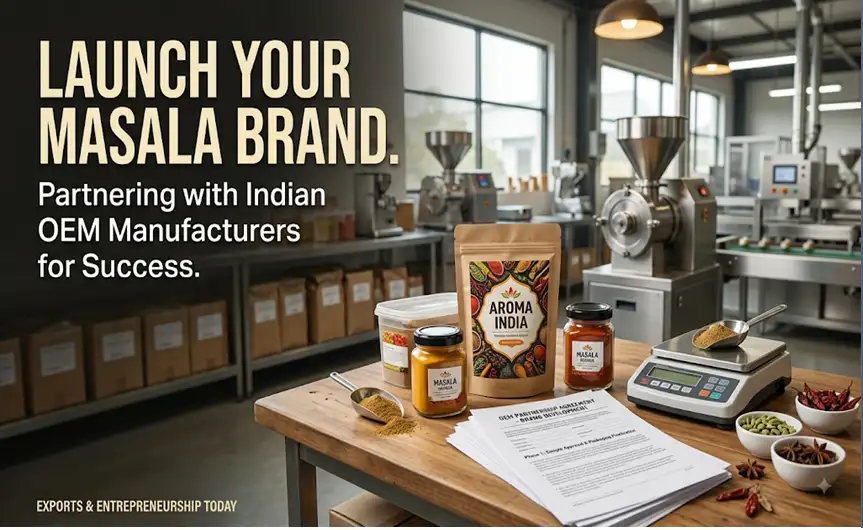
Many entrepreneurs assume that launching a masala brand requires a factory, grinding machines, production workers, and a large investment in infrastructure. An OEM partnership offers another route.
An Indian OEM manufacturer can produce your masala according to an agreed recipe or product specification. The finished product is then packed under your brand name and supplied to your target market.
This allows you to focus on brand positioning, customer research, marketing, sales channels, distribution, and retail relationships. The manufacturer manages the production side, but your brand still depends on the taste, quality, packaging, and consistency of the products being delivered.
Before approaching an OEM manufacturer, decide what makes your masala brand different. You may want to offer:
Your target customer influences the recipe, pack size, language, design, price, and sales channel. A brand for Western consumers may need milder blends, simple instructions, allergen information, and recipes printed on the packaging.
Launching with too many products can make your first order unnecessarily expensive. A focused range is often easier to test.
Your first line might include:
Blended masalas may offer more scope for branding, while single spices can be easier for customers to understand and compare. Consider starting with products that match your existing customer base.
An OEM manufacturer cannot produce your ideal product from only a product name. Your product brief should mention:
If you have an existing product, send a reference sample for evaluation. If you are developing a new formula, explain the taste you want and the price range you need to achieve.
A reliable OEM process should include sample development and approval.
Keep the final specifications in writing. This is especially important for repeat orders, because consistency is one of the biggest challenges in food branding.
Customers often judge a new masala brand by its packaging before trying the product. Common options include:
Choose the format according to your sales channel. Your label may need to include ingredients, net weight, batch number, production date, best-before date, storage instructions, country of origin, importer details, nutrition information, and allergen declarations.
Because labelling rules differ between countries, have the final artwork reviewed before packaging is printed.
The minimum order quantity for an OEM masala product depends on the recipe, number of products, pack size, packaging material, printing, and manufacturing setup.
Your costs may include:
Ask for a complete quotation and clarify whether the price includes packaging, testing, loading, and documentation. Include import duty, taxes, customs clearance, local transport, warehousing, marketing, and retailer margins in your business plan.
Before selecting an OEM manufacturer, ask how raw materials are checked and how finished products are tested. Important questions include:
The Spices Board of India provides export-related quality guidance, and certain products and destination markets may have specific sampling, testing, or certification requirements.
Exporters of spices may also need a Certificate of Registration as Exporter of Spices, commonly referred to as CRES, in addition to an Importer Exporter Code. See the Spices Board FAQ. Your importer or customs broker should confirm the exact requirements for the country where the masala will be sold.
If you are investing in a unique recipe, discuss confidentiality and ownership before production begins. Clarify who owns the final recipe, whether the manufacturer can sell the same blend to another customer, who owns the packaging artwork, how your brand name will be used, what happens if the product fails quality testing, and what the replacement or complaint procedures are.
These points should be included in a written agreement or purchase order.
Pratap Enterprises can help entrepreneurs, importers, and international brands explore Indian OEM and private-label masala opportunities.
You can discuss product ideas, custom spice blends, sample development, retail and bulk packaging, MOQ and pricing, quality requirements, export documents, and shipping arrangements. A detailed enquiry will help the team understand your product concept and provide more relevant guidance.
A strong masala brand is built through more than attractive packaging. It requires a repeatable recipe, reliable quality, clear positioning, practical pricing, compliant labelling, and a manufacturing partner who understands your market.
If you are ready to explore OEM masala manufacturing in India, contact Pratap Enterprises.
Yes. An OEM manufacturer can handle production and packaging while you focus on branding, sales, and distribution.
Yes, depending on the manufacturer's capabilities. You can provide a formulation, reference sample, or taste profile for development.
MOQ varies according to the recipe, pack size, printed packaging, number of products, and production requirements.
Yes, provided the product, packaging, labels, documents, and shipment comply with Indian export rules and destination-country regulations.
Share your masala concept, expected quantity, packaging preference, target country, and delivery timeline with Pratap Enterprises.
A strong masala brand is built through more than attractive packaging. It requires a repeatable recipe, reliable quality, clear positioning, practical pricing, compliant labelling, and a manufacturing partner who understands your market.
If you are ready to explore OEM masala manufacturing in India, contact Pratap Enterprises.
With this thought, we are committed to delivering clean, reliable and authentic spices to homes and businesses worldwide accross the Globe.
© 2026 Pratap Enterprises - All Rights Reserved
© Design and developed by - Injector Technologies