
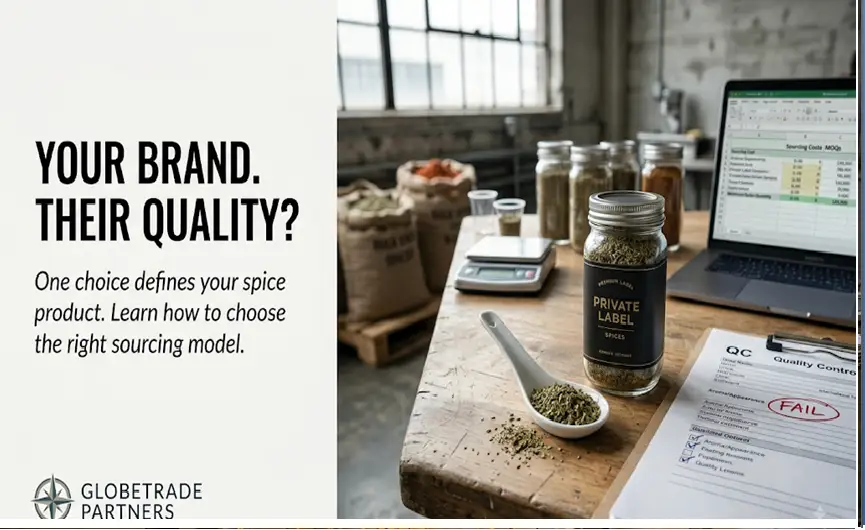
When a business decides to source spices from India, the first question is often, “Which supplier should I choose?”
There is another question that should come first:
What exactly do you want to buy?
An importer may need unbranded cumin in large bags. A supermarket may want turmeric packed under its own brand. A food entrepreneur may need a unique masala recipe that is not available from standard suppliers.
These requirements fall under three different sourcing models: bulk spices, private-label spices, and OEM manufacturing. Understanding the difference can help you choose the right investment level, supplier, packaging, and level of product control.
Bulk sourcing means purchasing standard spices in commercial quantities, usually without your own retail branding.
The products may be supplied in large food-grade bags, cartons, drums, or other wholesale packaging. You can then sell them to customers, use them in manufacturing, or arrange repacking in your destination country.
This model is generally suitable for:
You may source whole cumin, turmeric fingers, coriander seeds, dried chilli, black pepper, or powdered products.
The main advantage is simplicity. You do not need to develop a recipe or print custom packaging. You can focus on product quality, price, freight, and distribution.
Bulk buying may also be suitable for a buyer testing the market for the first time. However, the product will usually have less brand differentiation, and similar products may be available to other businesses.
You should also confirm whether the supplier is selling directly from its own facility or sourcing from another processor.
Private-label spices are produced and packed under your brand name. In many cases, the manufacturer provides an existing recipe or standard product, while you select the packaging, design, pack size, and branding.
For example, an importer may choose a supplier’s existing curry powder and sell it in custom pouches with its own logo and market positioning.
This model is commonly used by:
Private label offers stronger brand control than bulk sourcing without requiring complete product development.
You can decide:
The limitation is that the formula may not be exclusive. Other buyers may be able to purchase a similar product from the same manufacturer. If you need a completely distinct taste, ingredient ratio, or technical specification, OEM manufacturing may be more suitable.
OEM manufacturing is the most customised option. The manufacturer produces the spice or masala according to your recipe, reference sample, ingredient list, or technical brief.
This can include:
OEM is often chosen by established brands, restaurant chains, specialty retailers, and entrepreneurs with a specific product concept.
The major benefit is differentiation. You can develop a product based on your own customer research rather than selling a standard formulation.
However, OEM manufacturing usually requires more planning. You may need several sample rounds, laboratory testing, formulation approval, packaging development, and written agreements about recipe ownership and confidentiality.
It may also involve a higher MOQ and longer lead time than standard bulk buying.
Bulk sourcing gives you the least control but is usually the simplest route for volume purchasing.
Private label gives you ownership of the brand and packaging, while the product may be based on an existing or slightly adjusted formulation.
OEM gives you the greatest control over the product itself, but it also requires more development, communication, testing, and commercial commitment.
The right option depends on what matters most to your business:
Suppose you are a distributor in Dubai supplying Indian grocery shops.
You may begin by importing bulk turmeric, cumin, and chilli in commercial bags. This allows you to test demand and serve existing wholesale customers.
After identifying your best-selling products, you may launch retail pouches under your own brand. That would be a private-label model.
Later, you may develop a special biryani masala or curry blend for your brand. If the formulation is created according to your requirements, it becomes an OEM project.
This staged approach can help you avoid investing heavily in custom products before understanding your market.
Before confirming any model, ask:
For private-label and OEM arrangements, confirm the recipe, packaging artwork, quality specifications, and brand ownership in writing.
The product price is only one part of the buying decision.
Your total cost may include:
Bulk spices may have the lowest initial product cost, but private-label and OEM products may provide better margins if your brand achieves strong customer demand.
Pratap Enterprises can help international buyers explore different Indian spice sourcing options according to their business model.
You can discuss:
Share your product, quantity, target country, packaging preference, and branding requirement so the sourcing discussion can be more practical.
Bulk sourcing generally has fewer development and packaging costs. Private label and OEM products may cost more initially because of custom packaging, testing, and formulation.
No. Private label usually involves selling an existing or lightly customised product under your brand. OEM manufacturing involves producing a product according to your specific formulation or technical requirements.
Bulk sourcing or private label may be easier for a new importer. OEM can be considered after you understand your market and have a clear product concept.
Yes. Many businesses begin with bulk products, study customer demand, and later move into private-label or OEM manufacturing.
Contact Pratap Enterprises with your product requirement, quantity, packaging preference, destination country, and branding plans.
There is no universally best sourcing model.
Bulk spices are practical for volume and distribution. Private label is suitable for businesses that want their own brand without developing a completely new recipe. OEM is the strongest option for businesses seeking a distinctive product and greater formulation control.
The right choice depends on your customers, budget, timeline, expected order volume, and long-term brand plans.
For help sourcing spices from India, contact Pratap Enterprises.
With this thought, we are committed to delivering clean, reliable and authentic spices to homes and businesses worldwide accross the Globe.
© 2026 Pratap Enterprises - All Rights Reserved
© Design and developed by - Injector Technologies