
India is a major sourcing destination for businesses looking to buy spices in bulk. From turmeric and cumin to red chilli, coriander, black pepper, cardamom, ginger, and fennel, Indian suppliers offer products for wholesalers, distributors, food manufacturers, restaurants, and private-label brands.
However, successful bulk spice buying requires more than comparing prices. Buyers must understand the minimum order quantity, sample approval, product specifications, packaging, documentation, payment terms, and shipping process.
This guide explains the complete process for international bulk buyers.
Bulk spice buying means purchasing spices in commercial quantities rather than small retail packs. The products may be supplied in large bags, cartons, drums, or customised packaging, depending on the buyer’s business requirement.
Bulk buyers commonly include:
The right order quantity depends on your market demand, available storage, budget, shelf life, and shipping costs.
MOQ means Minimum Order Quantity. It is the smallest quantity a supplier is willing to produce or supply for one order.
There is no single MOQ for every Indian spice. It may vary according to:
For standard bulk products, suppliers may quote the MOQ in kilograms or metric tonnes. Custom retail packaging usually requires a higher MOQ because the manufacturer must arrange printed pouches, labels, cartons, and production setup.
Before requesting a quotation, share:
This helps the supplier provide a practical MOQ and accurate price.
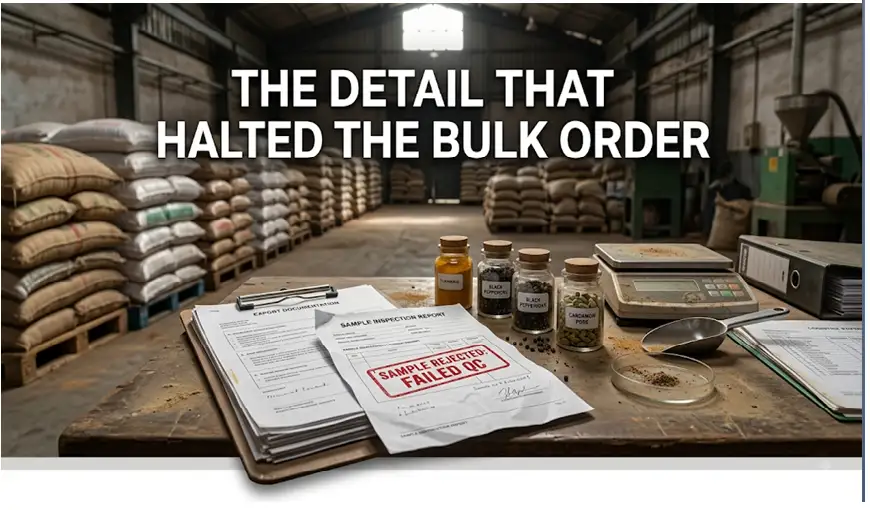
Sample approval is one of the most important stages in bulk spice buying. Do not confirm a large order based only on product photographs or a verbal quality promise.
When you receive a sample, check:
For powdered spices, laboratory testing can be useful before commercial production. Depending on the destination market, buyers may require tests for microbiological contamination, pesticide residues, aflatoxins, heavy metals, adulteration, moisture, and other safety parameters.
Ask the supplier whether a Certificate of Analysis can be provided for the approved product or shipment batch.
The approved sample should be treated as the quality reference for the final order. Mention the product specifications and sample approval in the purchase order.
Packaging protects spices from moisture, contamination, insects, sunlight, odour, and damage during transportation.
Common bulk packaging options include:
For wholesale orders, 25 kg or 50 kg bags may be suitable. For supermarkets or private-label businesses, smaller retail packs may be more appropriate.
Confirm whether the packaging is food-grade and suitable for the expected transport and storage conditions. If the product is being sold under your own brand, check the label requirements of your destination country before printing.
Labels may need to include the product name, ingredients, net weight, batch number, manufacturing date, best-before date, country of origin, storage instructions, importer details, and allergen information.
A clear product specification avoids misunderstandings between the buyer and supplier.
Your specification may include:
For example, “red chilli powder” is not a complete specification. You should also mention the desired heat level, colour, mesh size, moisture, purity, and intended application.
Requirements can vary by country. The Spices Board of India provides quality and export-related guidance, including testing requirements for selected spices and destinations.indianspices.org
The Indian spice export process generally involves the following steps:
Export documents may include:
The Spices Board states that exporters of spices and spice products require a Certificate of Registration as Exporter of Spices, in addition to an Importer Exporter Code.indianspices
Destination-country rules may require additional registrations, inspections, or food-safety documents. Buyers should confirm these requirements with their customs broker or local regulatory authority before shipment.
Compare the total landed cost instead of only the product price per kilogram
Your total cost may include:
Ask suppliers to quote under clear Incoterms such as FOB, CFR, or CIF. Also confirm payment terms, production time, shipping schedule, and responsibility for documents.
Pratap Enterprises can assist commercial buyers who want to source Indian spices for wholesale, distribution, food manufacturing, restaurants, or private-label sales.
You can discuss:
MOQ depends on the spice, grade, packaging, processing, and supplier. Standard bulk products may have a lower MOQ than customised private-label packaging.
Yes, buyers can request samples before confirming a bulk order. Sample approval should be based on agreed quality specifications.
Bulk spices may be packed in food-grade bags, kraft bags with liners, cartons, drums, vacuum packs, or customised retail packaging.
Common documents include a commercial invoice, packing list, certificate of origin, bill of lading, Certificate of Analysis, and applicable health, phytosanitary, fumigation, or inspection certificates.
Private-label packaging may be available depending on the supplier’s capabilities, MOQ, packaging design, and destination-country labelling requirements.
You can contact Pratap Enterprises for bulk spice enquiries through:
Planning to buy bulk spices from India?
Share your required spice, quantity, packaging preference, destination country, and delivery timeline with Pratap Enterprises. The team can help you explore suitable Indian spice sourcing and export options.
With this thought, we are committed to delivering clean, reliable and authentic spices to homes and businesses worldwide accross the Globe.
© 2026 Pratap Enterprises - All Rights Reserved
© Design and developed by - Injector Technologies