
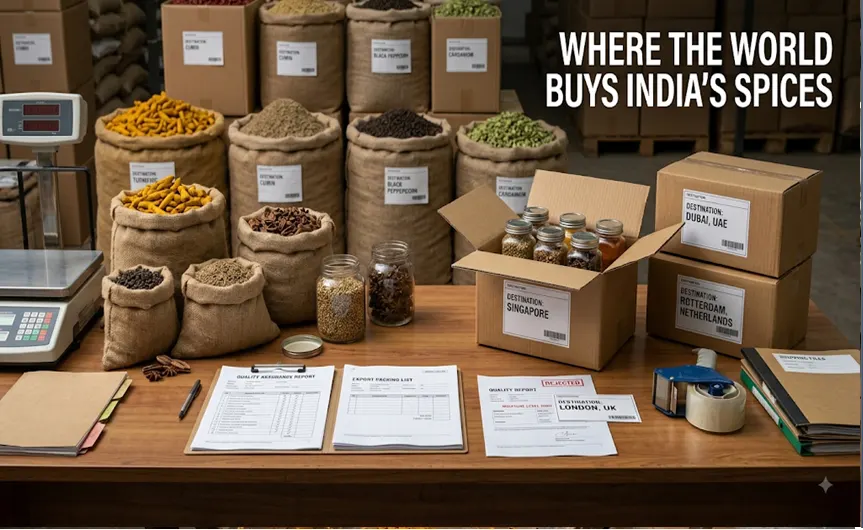
International buyers do not all purchase Indian spices for the same reason. Some markets import large volumes of whole spices for food processing. Others prefer retail-ready powders, private-label masalas, spice oils, or premium products with detailed quality documentation.
India supplies spices and spice products to a wide range of countries. Spices Board trade information lists the USA, China, UAE, Bangladesh, Saudi Arabia, the UK, Thailand, Malaysia, Indonesia, Germany, the Netherlands, Canada, Nepal, and Australia among important destinations.[indianspices]
For an importer, the useful question is not simply “Which country imports the most?” A better question is: Which market fits my product, packaging, quality level, and business model?
The United States is one of the most important markets for Indian spices. Buyers include food manufacturers, ethnic grocery distributors, restaurants, seasoning companies, and private-label brands.
Products may be supplied as:
The opportunity is large, but compliance must be taken seriously. Buyers may need to manage food-facility requirements, prior-notice procedures, importer responsibilities, labelling, and product testing.
For American buyers, a supplier should be able to provide consistent specifications, batch documentation, suitable packaging, and reliable communication. Products intended for retail sale also require labels that meet US requirements.
China is a significant destination for Indian spices and spice products. The market includes industrial food production, processing, seasoning, and ingredient businesses.
Bulk buyers may be interested in:
Price, volume, consistency, and shipment reliability can be particularly important for industrial buyers. Specifications should be agreed in detail because the requirements of a food factory may differ from those of a retail brand.
An importer supplying China should clarify the required grade, moisture, cleanliness, packaging, testing, and customs documentation before confirming the order.
The UAE is an important destination for Indian spices and also functions as a gateway to wider Middle Eastern and African markets.
Importers in the UAE may supply:
The market can support both bulk and retail products. Buyers may source whole cumin, chilli, turmeric, cardamom, pepper, curry powders, and ready-to-sell masala packs.
For re-export businesses, packaging and documentation must be planned carefully because the product may eventually move to another country. A supplier should understand the required shipping documents and packaging conditions for regional distribution.
Bangladesh has strong demand for spices used in household cooking, food manufacturing, and wholesale distribution. Its geographic proximity to India can support practical trade routes, although the buyer still needs to plan customs, transport, documentation, and border procedures.
Products may include:
For buyers in nearby markets, the shorter distance may help reduce transit time, but price competitiveness remains important. Product quality, packaging durability, and reliable dispatch schedules should still be confirmed.
Saudi Arabia and other Gulf markets offer opportunities for Indian spice exporters because of food-service demand, diverse consumer populations, and established trade links with India.
Potential buyers include:
The most suitable products depend on the customer segment. Food-service buyers may prefer large bags, while retail importers may require Arabic and English labelling, barcodes, and smaller packs.
The UK has demand for Indian spices among retail chains, food manufacturers, restaurants, and South Asian grocery businesses. European markets such as Germany and the Netherlands can also be attractive, but buyers generally need to pay close attention to food safety, traceability, pesticide residues, packaging, and labelling.
A European importer should ask for:
Certain products and destinations may have mandatory testing or health-certificate requirements. India’s Spices Board publishes updates on quality evaluation and export testing, so requirements should be checked for each shipment rather than assumed.[indianspices.org]
Southeast Asian markets import Indian spices for food manufacturing, restaurants, retail, and regional distribution.
Malaysia and Indonesia have strong culinary demand for chilli, turmeric, pepper, coriander, cumin, and spice blends. Thailand may also purchase spices for processing and food production.
Buyers in these markets should consider:
An Indian supplier may be able to provide standard bulk packaging or customise the product for a specific retail market.
These markets may offer opportunities for premium, organic, residue-tested, private-label, and retail-ready spices.
The buyer may need to focus on:
The opportunity may be smaller than a bulk industrial market, but margins can be stronger if the product is positioned correctly.
Before choosing a country, evaluate:
For example, a distributor may begin with bulk turmeric and cumin, while a brand owner may choose retail masala blends for a specific customer group.
Before placing an order, ask the supplier:
Pratap Enterprises can help importers, distributors, food businesses, and private-label brands explore Indian spice sourcing opportunities for different international markets.
You can discuss:
Important markets include the USA, China, UAE, Bangladesh, Saudi Arabia, the UK, Thailand, Malaysia, Indonesia, Germany, Canada, Australia, and other countries.
Chilli, cumin, turmeric, cardamom, black pepper, coriander, ginger, curry powders, masala blends, spice oils, and oleoresins are commonly exported.
The UAE can be attractive for wholesalers, retailers, food-service companies, and re-export businesses. Product choice and documentation should match the intended market.
Requirements vary by product and country, but European buyers often place strong emphasis on pesticide residues, microbiological safety, traceability, and labelling.
Contact Pratap Enterprises with your preferred product, quantity, destination country, packaging requirement, and expected delivery schedule.
Selecting the right Indian spice export market requires more than looking at demand figures. The best opportunity is where your product quality, pricing, packaging, compliance, and distribution plan fit together.
For sourcing assistance, contact Pratap Enterprises.
The best opportunity is where your product quality, pricing, packaging, compliance, and distribution plan fit together.
For sourcing assistance, contact Pratap Enterprises
With this thought, we are committed to delivering clean, reliable and authentic spices to homes and businesses worldwide accross the Globe.
© 2026 Pratap Enterprises - All Rights Reserved
© Design and developed by - Injector Technologies