
Starting a spice brand does not always require building a factory. For many international businesses, private label spice manufacturing in India offers a practical way to launch products without investing in grinding equipment, production staff, raw-material storage, and complete food-processing infrastructure.
Under this model, an Indian manufacturer produces spices or masala blends for your business. The final products are packed and sold under your brand name.
This can work well for supermarket brands, food distributors, restaurants, online businesses, importers, and entrepreneurs who want to create a differentiated spice range for their target market.
In a private-label arrangement, the manufacturer handles production while the brand owner controls how the product is presented and sold.
Depending on the agreement, the manufacturer may manage:
Your business may provide the recipe, packaging artwork, product concept, or quality specification. In other cases, the manufacturer can help develop the formula according to your preferred taste, aroma, colour, heat level, and price range.
The level of customisation should be agreed at the beginning because it affects the minimum order quantity, development time, and final cost.
Many new brand owners start by designing a logo and printing pouches. That is often premature.
First, decide what your product must deliver to the customer. It may be a mild curry blend for families, a high-heat chilli seasoning for restaurants, a premium turmeric powder, a regional masala for a specific diaspora market, or a clean-label spice blend with no artificial additives.
Your product brief should mention the ingredients, taste profile, colour, texture, pack size, shelf life, target market, and intended use. For powdered spices, you may also need to specify mesh size, moisture level, purity, heat level, or colour value. A clear brief prevents the manufacturer from making assumptions that may not suit your market.
A dependable manufacturer should be comfortable with a sample-based approval process.
Do not treat the sample as an informal reference. Record the agreed ingredients and important quality parameters in the purchase order or product specification. This becomes especially important when you plan repeat orders.
Private-label packaging must protect the product and meet the requirements of the country where it will be sold.
Common options include:
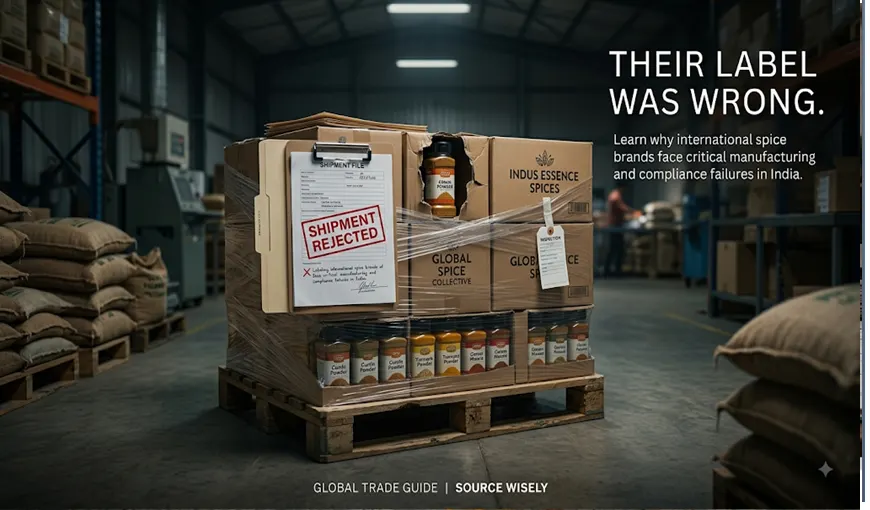
The correct format depends on your sales channel. Before printing packaging, confirm the destination-market rules. Labels may need to show the product name, ingredients, net weight, batch number, manufacturing date, best-before date, storage instructions, country of origin, importer details, and allergen information.
Do not assume that a label approved in one country will automatically be accepted in another.
Private-label manufacturing usually involves a higher MOQ than standard bulk spice buying. The manufacturer may need to purchase packaging materials, prepare printing plates, reserve production capacity, and manage a separate production batch.
MOQ can depend on the number of products, pack size, printed packaging, custom recipe development, product testing, manufacturing setup, and shipping destination.
Ask for a quotation that separates product cost, packaging cost, testing charges, documentation, and freight wherever possible. Calculate your complete landed cost, including Indian inland transport, export handling, freight, insurance, import duty, taxes, customs clearance, warehouse charges, and local delivery.
A serious international buyer should ask how the manufacturer controls raw materials and finished products. Important questions include where spices are sourced, whether raw materials are inspected, how batches are identified, what testing is performed, how products are stored, whether a Certificate of Analysis can be provided, whether traceability is available, and whether destination-country requirements can be met.
The Spices Board of India publishes quality guidance and destination-specific testing information for spice exports. Some consignments may require mandatory sampling, testing, or additional certificates depending on the product and market.
Exporters of spices and spice products may also require a Certificate of Registration as Exporter of Spices, known as CRES, in addition to an Importer Exporter Code. See the Spices Board FAQ for current guidance. The exact compliance requirements should be confirmed with the importer's customs broker and food-safety authority.
Do not select a private-label partner only on the basis of price. Evaluate product quality, sample consistency, production capacity, packaging capability, communication speed, documentation support, export experience, lead time, repeat-order reliability, and handling of complaints and replacements.
You may request factory photographs, videos, product samples, test reports, company details, and references where available. For a large first order, an independent inspection or factory audit may provide additional confidence.
Pratap Enterprises can support international brands exploring Indian spice sourcing and private-label opportunities. You can discuss individual spices, masala blends, product samples, bulk and retail packaging, brand-specific requirements, quality documentation, export paperwork, and shipping and delivery planning.
The more information you provide at the enquiry stage, the more accurately the product, pricing, MOQ, and timeline can be discussed.
If you are planning to launch a private-label spice brand, the right manufacturing partner can help you move from an idea to a market-ready product more efficiently.
Contact Pratap Enterprises to discuss your requirements.
Yes. You can provide an existing formulation or discuss your preferred taste, ingredients, aroma, colour, and heat level with the manufacturer.
It can be suitable because you can outsource production and focus on branding, marketing, distribution, and customer acquisition. The MOQ and investment should be evaluated before starting.
There is no universal MOQ. It depends on the recipe, product range, packaging, printing, testing, and manufacturer's production capacity.
Yes, subject to applicable product, packaging, documentation, registration, and destination-market requirements.
Send your product idea, quantity, packaging preference, destination country, and expected timeline to Pratap Enterprises for an initial discussion.
If you are planning to launch a private-label spice brand, the right manufacturing partner can help you move from an idea to a market-ready product more efficiently.
Contact Pratap Enterprises to discuss your requirements.
With this thought, we are committed to delivering clean, reliable and authentic spices to homes and businesses worldwide accross the Globe.
© 2026 Pratap Enterprises - All Rights Reserved
© Design and developed by - Injector Technologies