
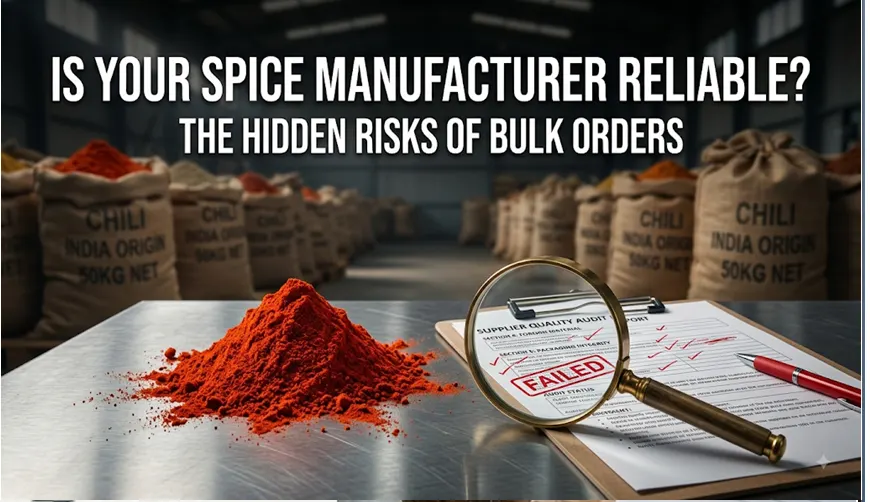
Finding the right Indian spice manufacturer can make a significant difference to your product quality, profit margin, and customer satisfaction. For commercial importers and distributors, the cheapest supplier is not always the best choice.
A reliable manufacturer should be able to provide consistent quality, proper documentation, suitable packaging, transparent communication, and timely delivery. Whether you want to import turmeric, cumin, coriander, red chilli, black pepper, cardamom, or blended spices, careful supplier verification is essential.
Here are the important factors to consider before placing a bulk order.
Start by learning about the supplier’s experience in spice processing and international trade. A manufacturer supplying local customers may not have the systems needed for export orders.
Ask the company:
An experienced Indian spice manufacturer should understand buyer specifications, export documentation, shipping schedules, and destination-market requirements.
Quality should be discussed in measurable terms rather than general words such as “premium” or “export quality.”
Ask for complete product specifications, including:
Quality requirements may differ according to the product and importing country. India’s Spices Board notes that export spices should meet applicable sensory, safety, quality, and hygiene requirements of the destination market indianspices
Never place a large commercial order with a new supplier without first checking a sample.
A sample allows you to evaluate:
For powdered spices, laboratory testing is also recommended. Depending on the product and market, tests may cover pesticide residues, aflatoxins, heavy metals, microbial contamination, adulteration, and moisture.
If possible, ask for a Certificate of Analysis related to the same batch that will be shipped.
A professional supplier should be able to explain its available registrations and certifications. The exact requirements depend on the product, destination country, and buyer’s application.
You may need to check for:
The Spices Board states that registration as an exporter of spices is mandatory for businesses exporting spices and spice products from India. Buyers should ask the supplier for current documentation and verify whether it applies to their proposed shipment.indianspices
Do not assume that every certificate is automatically valid for every country. Confirm the requirements with your customs broker or food-safety authority.
If possible, request photographs, videos, or a virtual inspection of the manufacturer’s facility. A clean processing area and organised warehouse can indicate better control over product handling..
Look for:
For very large orders, consider an independent factory audit or pre-shipment inspection. This may cost extra, but it can reduce the risk of receiving unsuitable goods.
A supplier may provide an excellent sample but struggle to maintain the same quality in a large order. Ask whether the manufacturer can supply the required quantity consistently.
Discuss:
If you are a distributor, consistency is especially important. Your customers expect the same colour, flavour, aroma, and performance every time they purchase the product.
Bulk spices may be packed in food-grade bags, kraft bags with inner liners, cartons, drums, vacuum packs, or customised retail pouches.
Ask the manufacturer:
Packaging should protect the spices from moisture, insects, contamination, sunlight, and damage during handling.
Do not compare manufacturers only on the price per kilogram. A lower product price may exclude testing, better packaging, inland transportation, documentation, or shipping-related charges.
Your landed-cost calculation may include:
Ask for quotations under clear Incoterms such as FOB, CFR, or CIF. This makes it easier to compare offers from different suppliers.
A reliable supplier should communicate clearly and provide documents on time. Delays in paperwork can create problems at customs and increase storage costs.
Common documents may include:
Also evaluate how quickly the supplier responds to questions. If communication is unclear before the order, it may become more difficult after payment.
The best Indian spice manufacturer is not merely the one offering the lowest quotation. It is the supplier that can support your business as your order volume grows.
A strong long-term supplier should offer:
Pratap Enterprises can help commercial buyers explore Indian spice sourcing options based on product, quantity, packaging, and destination requirements.
Before confirming a bulk order, ask:
Search for an experienced supplier, verify its business details, request samples, review certifications, inspect quality systems, and confirm previous export experience before placing a bulk order.
The MOQ depends on the product, packaging, processing, and manufacturer. Ask the supplier for the MOQ for your specific spice and packaging requirement.
Yes. Approve a sample and consider laboratory testing, especially for powdered spices and products intended for commercial food manufacturing.
Many manufacturers offer private-label packaging, subject to minimum order quantities, artwork approval, packaging availability, and destination-country labelling requirements.
You can contact Pratap Enterprises for bulk spice enquiries through:
Are you looking for a reliable Indian spice manufacturer for bulk orders?
Share your required spice, quantity, packaging preference, destination country, and expected delivery timeline with Pratap Enterprises. The team can help you discuss suitable sourcing and export options.
With this thought, we are committed to delivering clean, reliable and authentic spices to homes and businesses worldwide accross the Globe.
© 2026 Pratap Enterprises - All Rights Reserved
© Design and developed by - Injector Technologies